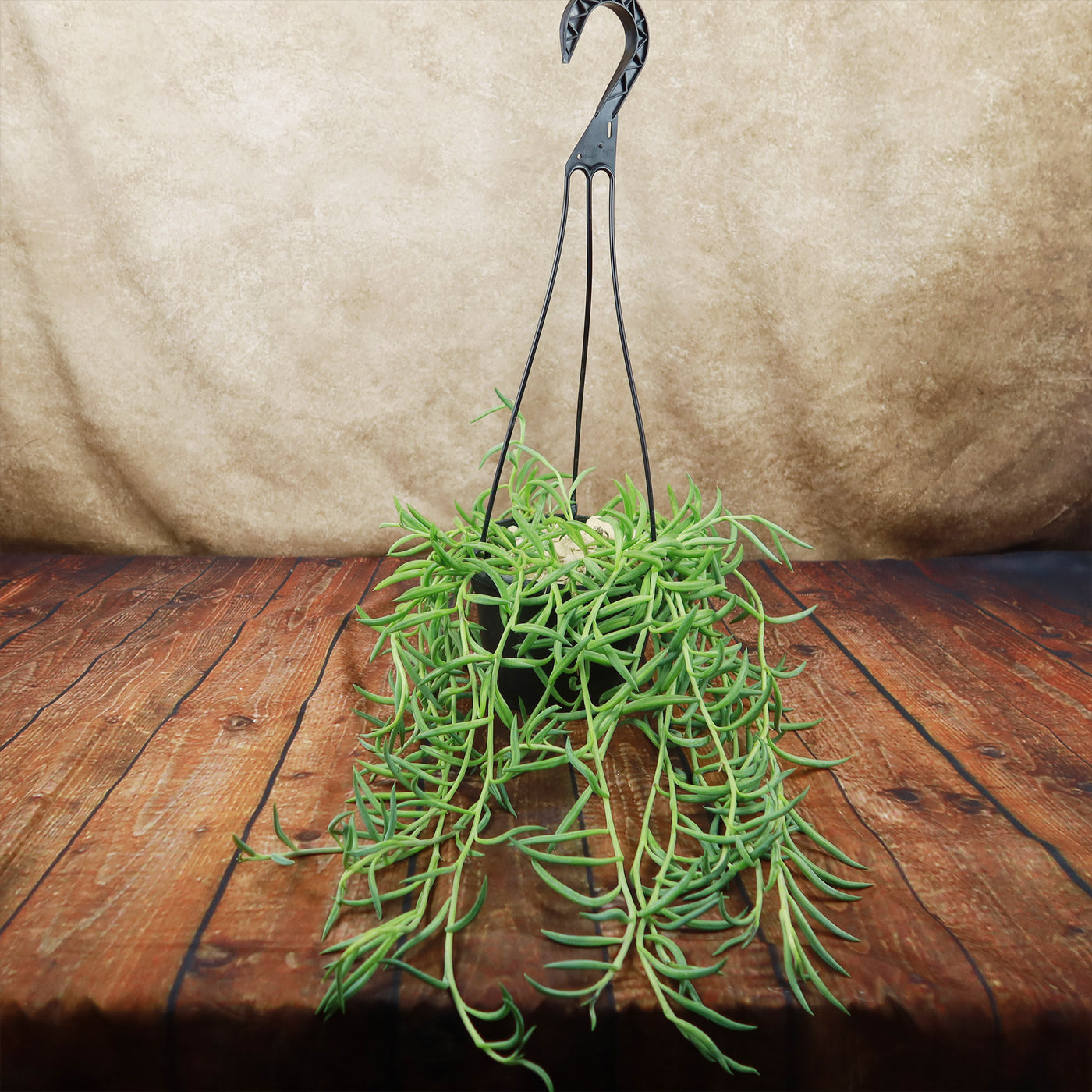
fish hook succulent toxic Shop 'String of Fishhook Plant - Senecio radicans glauca' Care and Growing  Guide
SKU: 65313176206
fish hook succulent toxic

fish hook succulent toxic Shop 'String of Fishhook Plant - Senecio radicans glauca' Care and Growing Guide

Sale price$25.31 Regular price$28.12
Save 10%

Pay in installments of $7.03 with ShopPay, AfterPay and Klarna

Shipping Estimate
USA
  • USA
  • CAN

Ships within 48 hours · Estimated delivery Jun 29 - Jul 4

Promo Codes Available:

For Your Every Summer RSVP, with Code: SUMMER15

Description

fish hook succulent toxic Shop 'String of Fishhook Plant - Senecio radicans glauca' Care and Growing GuideIntroducing the stunning string of fishhooks, scientifically known as Senecio radicans glauca, which is a trailing succulent variety of the Senecio radicans. The fish hook plant, also known as the blue pickle vine, is a hybrid trailing succulent that belongs to the Asteraceae family and is native to South Africa. The name "string of fish hook" comes from its distinctive appearance, as its leaves resemble tiny fishhooks. This fishhook Senecio plant

Introducing the stunning string of fishhooks, scientifically known as Senecio radicans glauca, which is a trailing succulent variety of the Senecio radicans.

The fish hook plant, also known as the blue pickle vine, is a hybrid trailing succulent that belongs to the Asteraceae family and is native to South Africa. The name "string of fish hook" comes from its distinctive appearance, as its leaves resemble tiny fishhooks. 


This fishhook Senecio plant features long, slender stems that cascade down, making it an excellent choice for hanging baskets or trailing down from shelves.

The stems are covered in small, cylindrical leaves that grow in pairs along the stems.

When the fishhooks plant has the proper growing conditions it grows very quickly and can get up to 32 feet tall. Whether you grow Fishhooks Senecio indoors or out, just make sure you give it room to trail!

The flowers of a string of fishhooks bloom from late summer to winter with daisy-like flowers. These delicate blooms are typically a creamy white or pale-yellow color and appear sporadically. While the Senecio flowers are not the main attraction of this hanging plant, they add a lovely touch when they do appear.

Most sites mix up the string of fishhook and string of bananas plants, but the glauca fishhook differs from the string of bananas (Senecio radicans) by having smaller, cylindrical leaves resembling fishhooks and a bluish-green color, whereas the string of bananas has elongated, banana-shaped leaves and a bright green color. Furthermore, the shape of 'Hooks' is longer and flatter than that of the string of bananas, which is rounded with a plump shape.

The Senecio radicans glauca fish hooks can be propagated from leaf or stem cuttings. This fish hook plant is not frost-hardy and winter-dormant. Avoid placing it directly under ACs, as it may cause leaves to droop. The fish hook plant looks best in hanging baskets as well as pots hung on walls. These can be grown in the driveway too. 

Watering Needs 

Succulents, like the Senecio Fish Hook plant, are excellent at withstanding drought or drought-tolerant fish hook plants. That's because the foliage of these succulent plants has the capacity to store water. Their leaves will explode if the soil is excessively wet or if you give them too much water.

Therefore, you typically only need to let the roots completely dry before watering them again. Watering them before they are completely dry can cause the roots to soak up water, which is bad because they are particularly prone to rotting. When your string of fishhook plants and roots get mushy, you'll recognize that something is wrong. 

If you notice the leaves trimming or wrinkling, this indicates that your Senecio plant needs to be watered. You ought to water these plants once every two weeks or so during the height of their growing season. 

You can dramatically cut back on that in the winter and only do it once a month. It's important to check the moisture level of the soil by sticking your finger about an inch deep into the soil. If it feels dry, it's time to water. If it still feels moist, wait a few more days before watering. 

Light Requirements

The glauca string of fishhooks prefers bright, indirect sunlight. If you are growing his hanging plant indoors it thrives when placed near a window with filtered sunlight or in a well-lit area of your home. Remember to rotate the fish hooks plant occasionally to ensure all sides receive adequate light for even growth.

When outdoors, ensure light shade and full sun indoors. Avoid exposing your fishhook plant to direct sunlight, as it can cause the leaves to burn.

If you notice the leaves stretching or becoming pale, it might indicate that the Senecio plant is not receiving enough light, so you can try moving it to a brighter location. 

Optimal Soil & Fertilizer Needs

The fishhook plant prefers well-draining soil. A good option is a succulent potting mix, which provides the right balance of moisture retention and drainage. You can also create your own potting mix by combining regular potting soil with perlite or pumice to improve drainage.

Planet Desert specializes in succulents and has specialized succulent potting soilGo to soil cactus mix blend 1 gal 4 qt cacti succulent dirt compost growing media that includes an organic substrate with mycorrhizae to help with the growth of a healthy root system to help your string of fishhook Senecios thrive.

When it comes to fertilizing, these fishhook plants don't require heavy feeding. A balanced (5-10-5) natural NPK fertilizer can be applied once a year during the growing season of spring. It's important not to over-fertilize, as this can lead to salt buildup in the soil and damage your fishhook succulent.

If the leaves start turning yellow or the Senecio succulent appears unhealthy, it may be a sign of over-fertilization, so it's best to reduce or stop fertilizing until the Senecio plant recovers.

Hardiness Zones & More 

When growing indoors, they prefer temperatures between 60-80°F during the day and slightly cooler temperatures at night. They become mushy when exposed to chilly temperatures for too long. So, throughout the winter, you should bring the pots indoors. If the air in your home is particularly dry, you can increase humidity by placing a tray of water near the plants or using a humidifier.

For outdoor cultivation, your fishhook plant is generally suitable for USDA hardiness zones 10-12. Like many other succulents, they can withstand heat well, but they can only withstand cold or moisture for a brief period of time.

This fishhook Senecio can adapt to both dry and moderately humid environments. However, they may benefit from slightly higher humidity levels, especially during the drier winter months. 

Remember, these are general guidelines, and it's always best to observe your specific plant's response to its environment and make adjustments accordingly. 

Final Thoughts

Overall, the String of Fishhooks (Senecio radicans glauca) is a fantastic trailing succulent that's perfect for hanging baskets or cascading down shelves. Its unique fishhook-shaped leaves give it a distinctive appearance. This plant loves bright, indirect light, so place it near a window where it can soak up some rays. When it comes to watering, it's best to let the soil dry out between waterings to prevent overwatering. This low-maintenance plant is a great addition to any succulent collection and adds a touch of whimsy to your space.

Give this succulent a try if you're looking for a beautiful plant Senecio radicans glauca - a string of fishhooks to care for! 

Shipping Notes
  • Free Standard Shipping on $100+ Orders to the USA.
  • Except Preorder products are shipped in 48 hours.
  • Delivery to the USA:
  1. Standard Shipping : 3-10 business days
  • If time is of the essence, please consider selecting expedited delivery for faster service.
Exchange/Return Notes
  • We offer a 30-day return/exchange service after receiving.
  • Final sale items are not eligible for returns or exchanges.
  • To process your return/exchange, please contact us at [email protected]
  • Please click here for more details>>> Return & Exchange Policy
SKU: 65313176206

Discover Niche Categories That Outsell fish hook succulent toxic

Top-Converting Item to Boost Your Average Order

4.5 ★★★★★
Based on 1689 reviews
Sort
Highest Rating
Newest First
Oldest First
Product Reviews
R
RSL
Charlottesville, US
★★★★★ 3
DNF
Format: Kindle
I decided to read this based on another review here. I started skipping and couldn't finish it. The writing is good but the behavior of the MCs put me off at times. Our parents took us camping (not car camping) a lot through my teens and the lesson was, from my youngest age, if the excrement encounters the turbine, get your bearings, assess, make a plan, follow it -- no time for drama. There would always be time for a freakout once the situation was resolved. (And if it wasn't resolved, freaking out wouldn't be an option.) Apparently, neither Helen nor Lana were ever taught that lesson because there's plenty of drama, and I lost respect for them. Worse, the drama continues with this endless back and forth right up to the very last page. I actually blinked. I've read rushed endings before, but this took the cake. Overall, this is a portrayal of women that bugged me. It felt almost stereotype-y regarding being overly dramatic and unable to keep it together under stress. Maybe I just hit the bad parts, but I couldn't keep reading to find out, in case there were more, and the repeated drama after the rescue didn't give me hope. Please, Sapphic authors, can we have more books celebrating feminine resilience? Cara Malone has a pretty good one about a bunch of shipwrecked queer women. We need more of that, and less of this. I'm giving this book 3 stars because the writing is good and I didn't finish, so may have missed better parts.
WAS THIS REVIEW HELPFUL?YesReportShare
Reviewed in the United States on July 23, 2024
P
Verified Purchase
Paula Cappa Reviews
Lake Worth, US
★★★★★ 5
If you can only afford one craft book on Dialogue, this one is it.
Format: Hardcover
The art of dialogue. How does a writer get it just right to be effective, yet original, dramatic but not too dramatic, captivating and satisfying, and most important of all convincing? The thrust of this book is how McKee spends time on characterizations and the art of the subtext—vital to thrilling and effective dialogue. McKee explains how subtext works, the thinking behind it, shows you its most effective moments, why it works well or poorly, and gives you the tools to make it work. The result: amazingly clear insight. No kidding, if you want to fully understand subtext in dialogue and sharpen your skills, this is the writing book to get. Conflict in dialogue, turning points, even sentence designs techniques. McKee describes the “suspense sentence” and the “periodic sentence.” Because prose is a natural medium for storytelling, you will learn how Charles Dickens used ‘counter pointing exposition’ and its effectiveness for the reader. I hadn’t seen this kind of hook in writing before, hadn’t heard this term before. Very powerful technique; of course none of us writes like Dickens, but what an example on how to swoop the reader in. What’s one of the takeaways in Dialogue by Robert McKee? “Quality storytelling inspires quality dialogue.” Which inspires a read of McKee’s other remarkable craft book “Story”—a great companion read as both books belong on any serious writer’s bookshelf.
WAS THIS REVIEW HELPFUL?YesReportShare
Reviewed in the United States on July 28, 2016
B
Verified Purchase
Bookworm
Pawtucket, US
★★★★★ 5
It's All Right Here. All of it.
Format: Hardcover
I shouldn't even be writing this review because doing so only creates my competition. I'm writing it for Robert McKee out of respect and love for him as one of the best instructors I've never met. I have both STORY and now, DIALOGUE in hardcover, on my Kindle, and the audio version (he narrates his books) in my headphones. I read it, I listen to it and take it with me when I travel. Sometimes I listen and read at the same time. Most nights I listen to the audio version in my sleep. In other words, I eat, sleep and breathe this book. I did the same thing with Story, his other book. I may go to my grave never fully comprehending the vast wealth of knowledge contained in these two books. That's OK. What I can tell you is this. With nothing but STORY as my guide, my very first screenplay took seven months and thirty-five drafts from start to finish. But. That screenplay became a Hallmark Movies and Mysteries feature film. The producers liked it so much they gave me another assignment. That one took six weeks, and they bought the first draft. I'm now working on my fifth script; this one is in the six-figure category, with five figures upfront just for the Treatment. And I owe it all to everything I've learned from studying Robert McKee, supplemented by what I learned from everyone else. Over the past thirty years, I’ve studied with forty plus instructors and highlighted hundreds of books and listened to dozens of recorded seminars. All that information is summed up and thoroughly explained in Robert McKee's two books STORY and now DIALOGUE. I won't live long enough to absorb everything he teaches. And I still study two hours a day as a warm up for my writing. I’d recommend Aaron Sorkin, Warner Hertzog, William Goldman (both Sorkin and McKee say he's the greatest), Blake Synder, Chris Vogler, Michael Hauge, William Akers, and anybody else you can find who’s willing to share their knowledge. Because you never know when a concept you didn’t realize you didn’t understand or needed is going to show up. Especially when presented from a different perspective. Having said that, if you are serious, and I mean dead serious, about becoming a working screenwriter, or any other kind of fiction writer for that matter, then you have no choice but to study McKee like your literary life depends on it. Buy the hardcover, buy the Kindle version, and buy the audio version of DIALOGUE and STORY. And supplement these two works with any other material that speaks to you. If you do this, you will become a first class screenwriter or novelist or playwright, because all three genres are only different ways of presenting a Story. If you can’t commit to this, unless you’re a genius or prodigy, you’re wasting valuable time which could be spent following your true life calling. But if your heart’s desire is to become a working writer, then sooner or later you’ll have to know everything in McKee’s two books. So, you might as well bite the bullet and jump in head first. It's all right here in STORY and DIALOGUE. All of it. Thank you, Mr. McKee. You, sir, changed my life.-- Jimmy Hager
WAS THIS REVIEW HELPFUL?YesReportShare
Reviewed in the United States on September 21, 2016
J
Verified Purchase
jk Smiles
Charlottesville, US
★★★★★ 5
A book on dialogue should be experienced first as a book on tape
Format: Audio CD
I think of this more as a great master class lecture. Dialogue should be seemingly simple (we all talk), but McKee defines its essence and differences for prose, stage and cinema. The bulk is narrated by McKee, but the scene examples are read by voice actors and they do quite well. Even the roots of the English language are examined in order to make better decisions on your character's particular use of words. After listening the 10 hours twice while commuting, I finally picked up the book and read it. The book on tape is a better way to initially absorb the material, while the actual book helps to clarify the info. A must for all writers, especially screenwriters.
WAS THIS REVIEW HELPFUL?YesReportShare
Reviewed in the United States on August 30, 2018
L
Verified Purchase
Lori T. Sly
Alexandria, US
★★★★★ 4
Helpful, but not as good as "Story" by same author, and it disses certain genres
Format: Hardcover
This book contains a lot of helpful information on how to write dialogue. It's dense with dialogue analysis and insights, tough to take in by just reading it through once. But it is helpful. McKee covers the three dialogue tiers (said, unsaid, unsayable) as well as how dialogue ties into story turning points and scene conflict type. I still have lots of practice ahead of me to figure out how best to do this in my story. I will definitely use his advice as a guide. He understands dialogue at a much deeper level than I do. However, many of McKee's dialogue examples did not speak to me. While I liked reading the dialogue examples for Breaking Bad, 30 Rock, The Sopranos, Frasier, A Raisin in the Sun, and The Great Gatsby, and agreed they were good, I disliked the dialogue from Shakespeare, Elmore Leonard, Sideways, Fraulein Else, and Lost in Translation. McKee says fine dialogue turns the reader/audience into a mind reader; I guess I'm not interested in movies which expect me to be as much of a mind reader as those latter examples did. I totally missed the subtext of the dialogue in those until he explained it to me as an aside. And that's after I already saw most of those movies! If I have to guess what every character means with every line, that's too much work and too little entertainment for me. Maybe mystery lovers liked the dialogue in "Lost in Translation"; I'm not a mystery lover. McKee quoted one novelist as saying that the crux of good writing is to, "Make em laugh, make em cry, make em wait." Lost In Translation and its dialogue did none of that for me. The subtext was so confusing and subtle that I lost interest in the movie. I can't even remember what it was about anymore, only that it won some award and I had no clue why. McKee says that with rare exceptions, a scene should never be outwardly and entirely about what it seems to be about. Dialogue should imply, not explain, its subtext. An ever-present subtext is the guiding principle of realism. Nonrealism, on the other hand, employs on-the-nose dialogue in all its genres and subgenres: myth and fairytale, science fiction and time travel, animation, the musical, the supernatural, Theatre of the Absurd, action/adventure, farce, horror, allegory, magical realism, postmodernism, dieselpunk retrofuturism, and the like. It's a bit unclear how, if at all, anyone writing in any of these "nonreal" genres should take his dialogue advice. It seems to me that even sci fi scenes need some good dialogue with subtext to be engaging. With McKee, all the accolades go to what is implied and unsaid over what is said. I agree that subtext matters, but for me, he's out of proportion with how much it matters to most people and how hard audiences are willing to work to discover the intended subtext. Also, memorable spoken character lines can elevate movie themes and characterization like nothing else. In the end, I think this book is geared more toward writers who want other advanced writers as their audience rather than the average reader or movie watcher. And McKee admits it is definitely not geared toward sci fi, fairytales/myths, action/adventure, horror or allegory. It's almost as if he's saying those genres can't have excellent dialogue. I disagree. But it was still a helpful book to read, and one I will be thinking about and trying to more fully understand for a long time. McKee understands how character's subconscious drives can deepen what they say or avoid saying, and how dialogue interacts with many other aspects of a story to make it all work together.
WAS THIS REVIEW HELPFUL?YesReportShare
Reviewed in the United States on December 12, 2019

recommand products